Home › Road, Street, and Municipal Paving
We handle municipal paving in Tucson, AZ for public roads, streets, and community facilities. Our crews are equipped for large scale asphalt projects, from new construction to overlays and rehabilitation. With careful traffic control and quality materials, we deliver smooth driving surfaces that serve residents safely for years.
Prestige Asphalt Tucson provides professional municipal paving throughout Tucson, AZ and the surrounding area. Our licensed, insured crew delivers safe, clean, on-time work with a free estimate before anything begins. Call (520) 462-7505 or request your free quote.
Road, Street, and Municipal Paving in Tucson
Road and street work in Tucson is different from paving in cooler climates. The sun, summer monsoons, and dry soil all affect how long asphalt lasts and how it should be installed. Prestige Asphalt Tucson focuses on municipal paving that is designed for these local conditions, not just a generic pavement section pulled from a book.
When a city, HOA, school, or public facility calls us, we start by walking the site in person. We look at existing cracking patterns, drainage paths, where water ponds after storms, and how the traffic actually flows. A residential side street with trash trucks and school drop off traffic needs a different design than a collector road that carries buses and delivery trucks all day. We confirm whether this is new construction or an overlay on an existing road, because the approach and cost are very different.
Local agencies in and around Tucson often have specific standards for thickness, mix type, and striping. Prestige Asphalt Tucson works within those standards, but we also point out where small design adjustments can improve performance, such as using a slightly stiffer mix for truck routes or adjusting cross slope to move water out of wheel paths faster. Our goal is a surface that survives both the daily heat and the intense but short monsoon downpours without raveling, rutting, or alligator cracking too early.
How Municipal Paving Projects Are Planned and Built
A successful municipal paving job starts before any equipment rolls. First, we complete a detailed assessment and, if needed, a core sampling of the existing pavement. Coring tells us how thick the old asphalt and base really are, and whether the subgrade is still supporting the loads. On older Tucson streets, we often find multiple thin overlays stacked on top of a weak base, which changes the repair strategy.
Next, we work with the owner or agency to define the scope: full reconstruction, mill and overlay, or targeted patching plus overlay. Full reconstruction involves removing the existing pavement and base, reconditioning or replacing the subgrade, installing new aggregate base, then paving new asphalt. Mill and overlay keeps the existing base and structural asphalt but grinds off a set depth on top, usually 1 to 2 inches, then paves a new surface course.
Scheduling is critical for municipal streets. Prestige Asphalt Tucson helps set up phasing so that emergency vehicles, school buses, and residents can still get through. For example, on a neighborhood collector, we may pave one side of the street at a time or use temporary gravel ramps at intersections. We also plan around Tucson’s monsoon season when possible, since heavy rain during paving can ruin a fresh mat and shorten pavement life. When work cannot be moved, we adjust shift start times and staging so that fresh asphalt is placed and compacted well before afternoon storms typically build.
Materials, Mix Designs, and Thickness Choices for Tucson Roads
Local temperature swings and solar exposure drive most of the material decisions for municipal paving in this area. Prestige Asphalt Tucson typically uses hot mix asphalt produced at local plants, but we do not just accept a generic mix. For heavier use roads, we often recommend a PG 64-22 or PG 70-10 binder that holds up better under Tucson’s summer pavement surface temperatures, which can exceed 150 degrees on dark asphalt.
Thickness depends on expected traffic and base conditions. A low traffic residential street may only need 3 to 3.5 inches of total asphalt over a properly compacted base. A bus route or industrial access road usually requires 4 to 6 inches, with the lower lift using a coarser, stronger base mix and the top lift using a finer surface mix for a smoother ride and better sealing. When budgets are tight, we explain the tradeoff between slightly thinner sections and long term maintenance so decision makers can choose knowingly, not blindly.
We also address Tucson’s frequent drainage issues. Many older streets have flat grades and minimal gutter capacity, so water sits in the wheel paths and accelerates cracking. When we design or rehabilitate these streets, we may introduce a more pronounced crown (slight center high point), adjust gutter tie in points, or add localized grading corrections at intersections so water drains out. These details cost a little more up front but significantly reduce pothole formation after monsoon events.
For dust control on unpaved municipal or county roads, we can phase improvements. First comes grading, then adding and compacting a base material, and finally an asphalt surface treatment or full hot mix surface. This step approach helps public agencies stretch limited road budgets without leaving residents in permanent washboard conditions.
Common Problems on Tucson Streets and How We Address Them
Tucson’s municipal streets often show a similar set of problems: reflective cracking from old joints, fatigue cracking in the wheel paths, raveling where the surface has dried out, and localized base failures that turn into recurring potholes. Prestige Asphalt Tucson does not simply pave over everything and hope for the best. We match the repair to the actual failure pattern.
For alligator cracking and soft spots, we saw cut and remove the failed area down to firm subgrade, then rebuild with new base and asphalt. If we skip that step, those cracks and dips come right back through a new overlay. For long linear cracks that are otherwise stable, we clean and seal them with hot pour material before any overlay, which slows reflective cracking.
Where raveling or surface oxidation is the main issue, a thin overlay may be enough if the underlying structure is sound. In these cases we sometimes use a finer mix that seals better against UV and water intrusion. If the budget cannot support an overlay yet, we can discuss interim preservation options such as crack sealing paired with localized patching to buy time until funding is available.
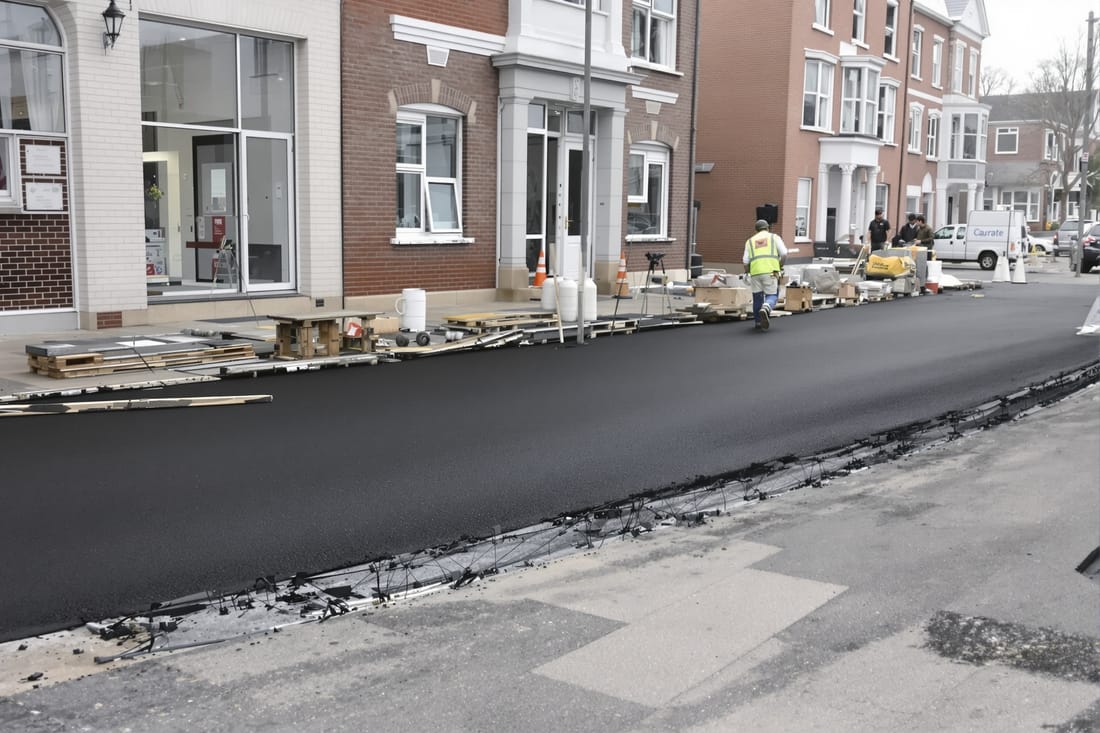
Traffic control on active streets is another common challenge. We set up MUTCD compliant signage and flagging so drivers have clear instructions around the work zone. For busy intersections, we often schedule the heaviest operations during off peak hours or weekends. Our crews are trained to keep access to driveways, schools, and public facilities open wherever possible, using temporary ramps and clear markings.
Finally, compaction and joint quality are key for long lasting municipal paving. Tucson’s low humidity means asphalt can lose temperature quickly, especially on cooler mornings. We run adequate rollers and choreograph passes so we hit density targets before the mix cools below spec. We also pay close attention to longitudinal joints where two paving passes meet, as these are common weak points that can open and ravel early if not built and compacted correctly.
What Affects Cost and How Prestige Asphalt Tucson Works With Budgets
Road, street, and municipal paving costs in Tucson are driven by a few big factors: project size, thickness and type of asphalt, condition of the existing base, drainage corrections, and traffic control requirements. A simple mill and overlay on a sound base is usually the most cost effective option. Full reconstruction costs more but may be the right choice where there are deep base failures, chronic ponding, or decades of patchwork repairs.
Material quantities are the biggest line item, so thickness and project length matter. When we prepare a proposal, Prestige Asphalt Tucson breaks out the cost for each major item: milling, base repair, asphalt tonnage, striping, and any concrete work like curb adjustments or ADA ramps. This helps city staff, HOAs, and facility managers see where money is going and adjust scope if needed, for example prioritizing heavily traveled segments first and deferring cul de sacs or parking bays.
Access and traffic control can also add cost, especially on arterials or streets with schools and medical facilities. Night work or weekend work may require premium labor rates, but sometimes this approach reduces overall disruption and speeds completion, which can be a net benefit for municipalities and the public.
Before hiring any contractor for municipal paving in Tucson, it helps to ask a few specific questions: How will you handle soft spots you encounter after milling, and what is the unit price for those repairs? What density targets do you use and how do you verify them? How will you maintain access for residents, emergency vehicles, and trash pickup? Prestige Asphalt Tucson answers these questions in writing before work begins and updates owners daily once work is underway, so there are no surprises and the finished street performs as expected in the real conditions we see in southern Arizona.